


Find out the Legends of Borobudur Temple
Visit and tour Borobudur temple is the only way to know and reveal the legends of Borobudur temple, apart of the histories and facts of this amazing Buddhist temple in Indonesia. This might be not the only one huge temple in Java island, but Borobudur temple is the only one that is preserved well (even perfect) by nature.
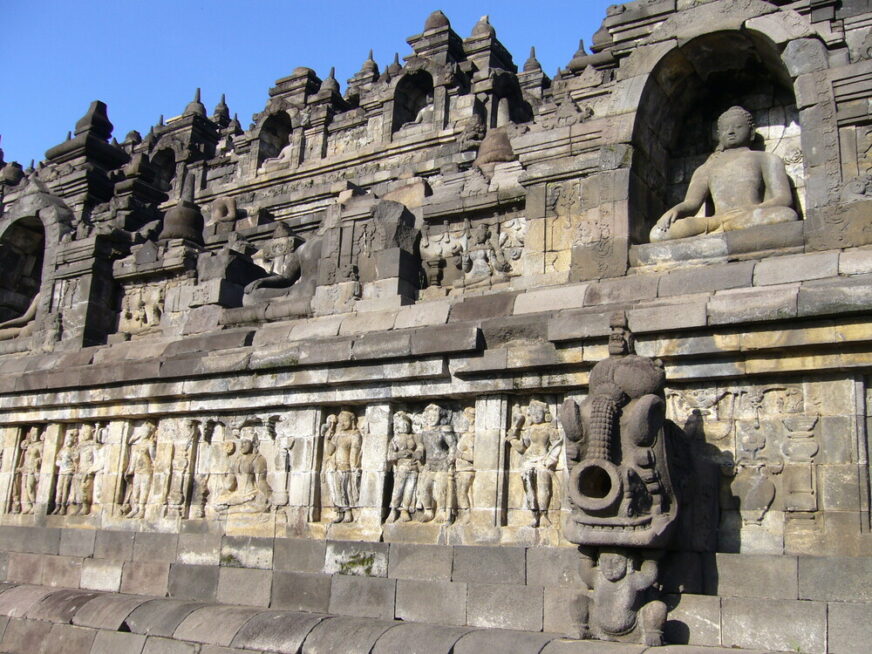
Viewed from the air, the temple has been interpreted as a representation of the universe. It was built in the shape of a gigantic mandala-yantra to allow a pilgrim to walk through different levels in a symbolic search for enlightenment. The top three levels of the monument display 72 bell-shaped stupas, 70 of them encapsulating a statue of the Buddha in meditation. At the top in the center of the monument is a huge 30 foot high mother stupa. The top platforms of Borobudur temple also provides a great viewing platform to look at the surrounding landscape and see rice fields, villages, mountains and volcanoes. Merapi recently erupted in 2010 covering the temple with an inch of ash and killing all of the surrounding vegetation, so nature continues to exert its control over Borobudur’s future.

The incredible symmetry and workmanship of the monument has led most experts to conclude that as many as 30,000 craftsmen worked on Borobudur. The building of Borobudur is even more impressive when you consider that it predated by several hundred years the other treasured ruins of Southeast Asia such as Angkor Wat, the temples of Bagan in Myanmar, and Ayutthaya in Thailand.
- Borobudur temple’s Architecture was Gunadharma from India – a legend
- It was build in the middle of a Lake – a legend – could be a fact but no supporting evidence / insriptuions
- It was built by King Solomon
- It was built by UFO
- The central pilgrimage for Buddhism in the world
Raffles’ Rediscovery
Colonial traders from Portugal and then The Netherlands who colonized almost all of Indonesia between the 16th and 19th centuries showed little interest in the ruins or legends of Borobudur. That was not the case when Thomas Stafford Raffles, the Lieutenant Governor of Java from 1811 to 1816, presided over the island during a brief period of British administration. Raffles later became famous in 1824 as the official who made the city of Singapore a British possession. In 1814, having heard about many ancient places in Java, Raffles sent a Dutch engineer named H.C. Cornelius to investigate reports of crumbling and overgrown ruins.
With a team of 200 workers, Cornelius managed to clear the site. His efforts revealed the existence of a huge structure which was visited by Raffles on several occasions. Although the top portion of the temple had collapsed, enough information was gathered for Raffles to describe the temple in his 1817 book “The History of Java” as follows: “Boro Bodo is a square stone building consisting of seven ranges of walls, each range decreasing as you ascend, till the building terminates in a kind of dome… This is surrounded by a triple circle of towers in number seventy-two, each occupied by an image looking outwards, and all connected by a stone casing on a hill which externally has the appearance of a roof… The walls which support these terraces are covered with the richest sculpture on both sides.”
Shortly after the rediscovery of Borobudur by Raffles, the British returned control of the East Indies to the Dutch. Thereafter, other than becoming a target for official and unofficial looting of relics, the site languished except for some limited repairs performed in the early 20th century. Finally, the government of Indonesia with the assistance of UNESCO and private donors organized a Save Borobudur campaign in 1968. The plan included the full cleaning and restoration of the site including solving the internal drainage problems which threatened the integrity of the entire building. After completing the restoration in 1983, Borobudur became available for regular tourist visits and it achieved World Heritage site designation in 1991.


Gigantic temple!!
Although I have seen many temples in Southeast Asia, Borobudur is an absolute highlight! It is only on ascent that the incredible size becomes aware. In the lower galleries you can see great reliefs before you see the famous stupas at the top – madness! Visitors are regulated by the fact that you only come upstairs with a guide. You get flip flops and a bottle of water with the purchase of the ticket. You also have some time for your own explorations once the tour is complete. I just stayed a little longer at the end and then walked alone to the entrance in about 25-30 minutes, which was no problem either. At the end of the day there was much less going on and I would recommend a low-cost time for a visit. In high season, booking tickets in advance certainly makes sense. I spontaneously booked a ticket on site (at the beginning of April). [marco1981_travel].
Largest Buddhist Temple in the World
Borobudur Temple is the largest Buddhist temple in the world according to some sources. Angkor Wat in Cambodia is suppose to be the largest religious monument in the world. Angkor Wat started out as a Hindu temple and gradually transformed to a Buddhist temple. Having now visited both Borobudur & Angkor Wat, even though Borobudur was built a century early, Borobudur is just as magnificent and better preserved than Angkor Wat. The rock reliefs on the walls are defining and sharp. Perhaps this is due to limited admission time slots, avoid overwhelming number of tourists, a requirement to wear their sandals (your souvenir) to reducing erosion, and a temple tour guide to escort visitors around. Don’t miss the rediscovered “hidden foot level” located at the south-eastern corner. The upper Ampadhatu levels represent nirvana. Note the diamond shaped openings on the lower 2 rows of stupas and the square shaped openings on the top row. The 72 openwork stupas each contain a statue of the Buddha. The main stupa’s spire fell and couldn’t be restored due to missing original stones. Be aware that there are different types of tickets, including those for climbing the temple structure and those for accessing the grounds only. We bought the VIP ticket package with drinks and snacks afterward. We were driven to a separate entrance bypassing the regular queue. VIP tickets allow for climbing Borobudur’s nine stacked platforms.